If you’re a firm with expertise in nuclear technology and looking for your next major growth opportunity, Southeast Asia should be a high priority.
Governments across the region are revisiting nuclear policy, launching feasibility studies and engaging with suppliers.
Several countries are moving from theoretical discussion to the first concrete steps towards pilot deployments in the early 2030s. And, for overseas companies – particularly those focused on Small Modular Reactors – this presents a rare chance to shape energy policy and gain first-mover advantage before procurement and development begins.
In this article, I explain what’s driving renewed interest in nuclear energy across Southeast Asia, where momentum is strongest, what this means for overseas innovators and what it takes to succeed in this complex, highly-regulated space.
Southeast Asia’s growing energy appetite
Electricity demand is rising sharply across the region, as industrialization, urbanization and digital growth are pushing grids to their limits.
Governments face two conflicting pressures: they must secure reliable supplies to support economic expansion, while cutting emissions to meet national climate commitments. Most countries still rely heavily on imported coal and gas and this dependence is increasingly expensive and at odds with net zero strategies.
Businesses are also feeling the strain. Manufacturers, data centers and industrial parks want long-term stability and cleaner power sources. Many have begun to ask their governments for alternatives that offer both climate compatibility and round-the-clock reliability.
And nuclear power – particularly in the form of Small Modular Reactors (SMRs) - is re-entering the conversation as a strong contender.
The potential of small modular reactors
SMRs are a new generation of compact nuclear power systems designed for flexibility and lower upfront costs. Instead of building one enormous plant, governments can deploy smaller units in a phased approach.
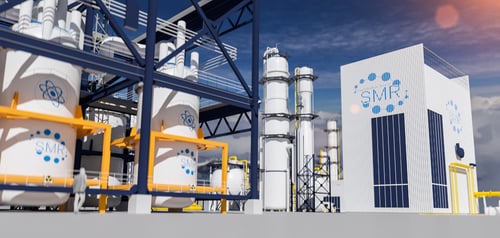
And this fits the needs of countries – such as those in Southeast Asia – with relatively small grids and islanded areas, where large reactors would be impractical.
SMRs offer stable baseload power with no carbon emissions. They also align closely with national energy security goals. A single, 200-MW reactor can replace large volumes of imported fossil fuels, while providing predictable long-term costs.
While no firm procurement commitments have yet been made, each country in Southeast Asia is taking concrete steps forward into the world of SMRs and assessing pilot deployments in the range of 50 to 300 MW per unit or cluster.
The earliest rollouts are projected for the early 2030s. If successful, these could scale up to several hundred megawatts, depending on regulatory progress, financing, cost competitiveness and national energy strategy.
And Canada, the US, South Korea and the UK are already moving forward with capacity building, feasibility discussions and technology study partnerships in the region.
Momentum by country
Singapore has long relied on regional electricity imports and gas‑fired generation, but rising energy costs and decarbonization targets are prompting a closer look at nuclear options.
In September, Singapore’s Energy Market Authority appointed British engineering group Mott MacDonald to conduct a study into advanced nuclear technologies including water-cooled SMRs and Generation IV designs, which use novel cooling systems or fuels. The two-year exercise will evaluate the safety, technological maturity and commercial readiness of these technologies to inform the nation’s future energy decisions.
Indonesia has explored nuclear options for many years and is now evaluating siting, regulatory readiness and financing models.
It has conducted pre-feasibility studies and, in March, the country’s PT Thorcon Power initiated the licensing process for the construction of a power plant based on its advanced molten salt reactor technology.
Energy officials have publicly discussed first unit deployment around 2032–33, and the National Research & Innovation Agency is developing a Generation IV power reactor to produce electricity while supporting clean hydrogen production for national industrial needs.
Meanwhile, the Philippines is progressing developments quickly.
Its Department of Energy and the National Electrification Administration have conducted studies, hosted consultations with international suppliers and begun preparing regulatory concepts. And nuclear readiness is now a core element of national energy planning, with the country aiming to bring its first nuclear capacity online around 2032 as part of a broader plan to diversify its energy mix.
Vietnam shelved its earlier large-scale nuclear project but is re-engaging through SMR studies and cooperation with the International Atomic Energy Agency (IAEA).
Long-term energy system modeling indicates that nuclear power will become necessary as coal is phased down, with the country’s first nuclear capacity, potentially SMRs, expected in the early 2030s.
Malaysia and Thailand are moving cautiously but steadily, with policy reviews, capacity-building programs and early-stage support from international agencies.
Malaysia is targeting potential SMR deployment by 2035, while Thailand’s draft national plan anticipates an initial 600 MW of SMR capacity by 2037, scaling up towards 3 GW by 2050.
Both countries see nuclear as a component of their long-term energy diversification.
At a regional level, ASEAN forums are discussing harmonized readiness frameworks. The IAEA continues to support training, regulation and safety cooperation and, taken together, these developments indicate genuine appetite rather than exploratory rhetoric.
Where the region needs overseas innovators
Across Southeast Asia, governments are investing in early-stage capability building. This includes drafting initial regulatory concepts, strengthening national nuclear agencies, upgrading safety laboratories and building research partnerships with international institutions.
Some countries are also beginning to map potential sites and grid integration requirements.
However, no ASEAN country currently has the full technical, regulatory or industrial capacity to deploy an SMR without extensive overseas collaboration. And this is opening clear opportunities for international engineering and technology firms.
More specifically, the region needs outside expertise and support in:
- Engineering and reactor technology: Southeast Asia’s companies cannot yet manufacture reactor components or containment systems, so overseas suppliers with proven designs are essential.
- Regulatory development: most ASEAN regulators are at the beginning of their nuclear journey and need guidance on licensing models, quality assurance, environmental assessment and long-term waste management. The region’s countries are seeking partners with experience in developing nuclear rules from the ground up.
- Safety systems and digital technologies: there’s strong interest in advanced monitoring tools, predictive maintenance systems, emergency response technologies and cybersecurity solutions.
- Workforce development: skills gaps are significant and training programs in reactor operations, safety culture and nuclear project management are high priorities for governments preparing for pilot deployments.
- Financing and project structuring: nuclear financing is complex and unfamiliar to the region. International firms with experience in structuring long-term projects, including government-to-government partnerships and public-private models, will be highly valued.
So, for companies with relevant engineering, advanced manufacturing, digital safety systems and regulatory expertise, Southeast Asia is fast becoming a strategic market.
There are considerable opportunities to export components and systems, provide regulatory advisory services, deliver training programs and support feasibility work. And the region’s governments are looking for partners that can help de-risk early-stage projects, including providing demonstration data, safety case support and integration studies that show how SMRs can work within local grids.
There’s also room for collaboration models beyond simple technology exports. Joint ventures with utilities, licensing partnerships for specific reactor modules, long term service agreements and government-to-government frameworks are all under discussion.
Being present early and contributing expertise will help international companies to shape how these models develop and position themselves effectively to play a meaningful role.
Overcoming the challenges
Despite the opportunities, however, entering the Southeast Asian nuclear market is not simple.
This is one of the most regulated sectors in the world. Licensing processes are evolving and will take time to mature, and regulatory uncertainty will remain until countries complete their first rounds of rulemaking.
Political changes can also slow progress as new administrations may revisit timelines or shift priorities. So, companies should prepare for long engagement cycles and maintain broad relationships across ministries, regulators and utilities.
Financing is another hurdle. Many ASEAN states have limited experience with nuclear project finance, so firms should be ready to propose realistic, bankable models and work closely with export credit agencies.
Cultural and capacity challenges add a further layer. Training needs are high. Safety culture must be built from scratch. Companies that invest in long-term partnerships, rather than transactional sales, will gain trust and influence.
Central players
The good news is that these challenges are far from insurmountable.
With a clear market entry plan, strong local engagement and a commitment to safety and transparency, overseas innovators can become central players in Southeast Asia’s next major energy transition.
To discuss the potential of your nuclear power technologies or services in Southeast Asia, contact Priyankar at priyankar.bhunia@intralinkgroup.com

Priyankar is our Head of Delivery for Southeast Asia, supporting international companies in advanced technology fields with market entry, partner identification and strategy development. Fluent in English, Hindi and Bengali, Priyankar holds an MBA from the Indian Institute of Management and a BTech in Chemical Engineering from the Indian Institute of Technology.