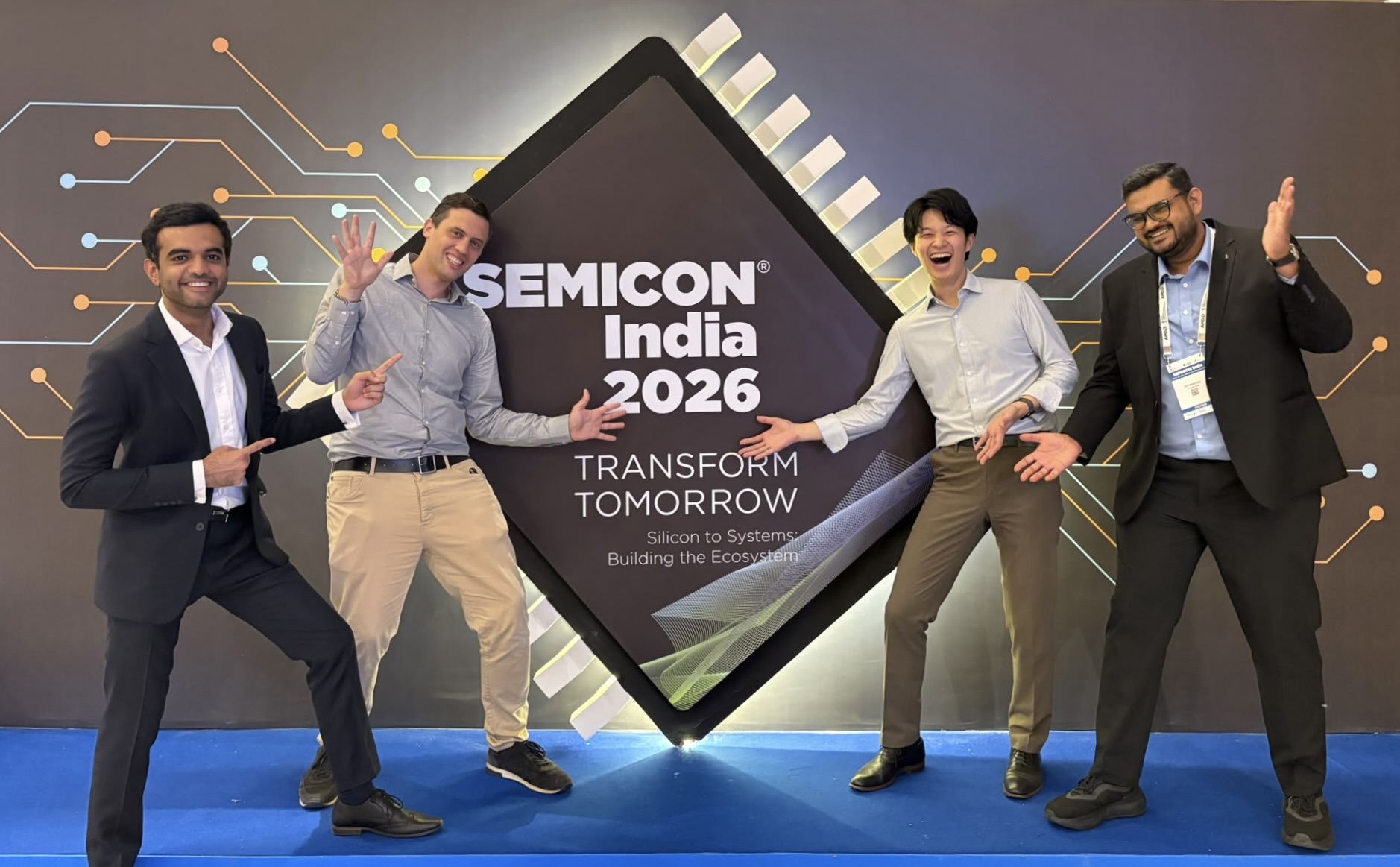
SEMICON India gets bigger with each passing year. This time, more than 600 companies and representatives from 52 countries came to Delhi, complete with six country pavilions and 12 Indian state booths.
But aside from the the scale, what struck me the most was how quickly the gaps in India's semiconductor ecosystem are starting to fill.
The Indian supply chain is getting broader
There were noticeably more Indian SMEs across the value chain compared to previous years.
Design is the most mature part of the domestic ecosystem. India already has a deep engineering base, but we are now seeing more local companies develop their own semiconductor products and IP. Government programmes such as the Design Linked Incentive scheme are helping domestic companies, startups and MSMEs access funding, EDA tools, prototyping and other design infrastructure.
Manufacturing and packaging are also moving forward. India now has multiple semiconductor fabs and packaging projects underway, including those spearheaded by Tata Electronics, CG Semi, Kaynes and the HCL-Foxconn venture.
.jpeg?width=743&height=487&name=Image%20(22).jpeg) Tata’s planned OSAT facility
Tata’s planned OSAT facility
What surprised me, though, was everything around them.
I met Indian companies supplying valves, high-purity piping, ultra-pure water systems, cleanroom materials, PPE and other products needed to build and operate semiconductor facilities. These businesses may receive less attention than fabs and chip designers, but their emergence matters. More of the supporting semiconductor supply chain can increasingly be sourced locally, giving international companies entering India access to a broader base of suppliers, capabilities and potential partners than might be immediately obvious from outside the market.
Japan showed up in force
Among the many international collaborators in India’s semiconductor industry, Japan was particularly difficult to miss.
From what I saw on the exhibition floor, Japanese companies formed the most vibrant overseas group, spanning semiconductor equipment, materials, components and supporting technologies. Japan and India are steadily deepening their semiconductor relationship, spanning supply chains, investment, R&D and startup collaboration.
For western semiconductor scaleups, this creates a particularly interesting opportunity.
Generally speaking, Japanese companies excel in semiconductor equipment, materials, components and process technologies, while western scaleups may bring complementary capabilities in software, IP, sensing, photonics, inspection or advanced manufacturing.
In other words, western innovation, Japanese industrial capability and Indian customers can increasingly come together within the same market.
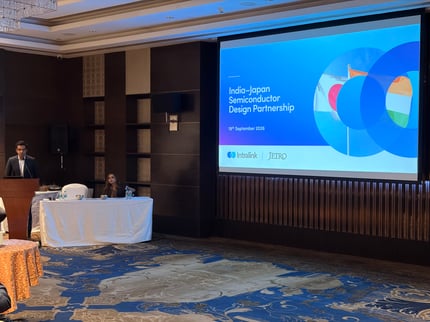
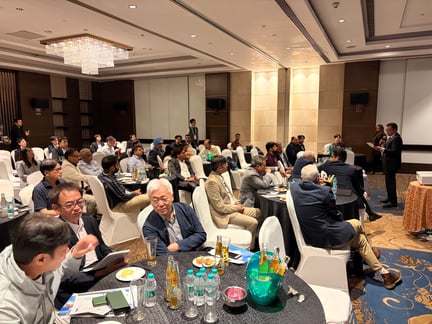
Jai Mallick, MD of our India operation, presenting on India-Japan Semiconductor Design Partnership at JETRO's event for Semicon India 2026
Japan wasn’t alone. South Korea, Malaysia, Singapore, Sweden and the Netherlands all had official country pavilions actively promoting companies and looking for opportunities for investment and collaboration. The event formally featured six international country pavilions this year.
The message was clear: countries do not want to watch India's semiconductor industry develop from the sidelines. They want their companies embedded within it.
Indian states want the investment too
The same competition was also playing out domestically.
Tamil Nadu, Karnataka, Maharashtra, Odisha, Uttar Pradesh and several other state governments had their own presence, pitching infrastructure, incentives, talent and industrial ecosystems to prospective investors.
And this is not relevant only to companies planning billion-dollar fabs.
States are competing across semiconductor design, R&D, packaging, electronics manufacturing, equipment and supporting industries as well. For an international scaleup, choosing the right cluster can therefore affect access to talent, customers, suppliers, infrastructure and government support.
The practical opportunity may be to establish a relatively small Indian base close to the right ecosystem first, rather than trying to build a large standalone operation from day one.
What companies actually asked us
The most useful insight came from our conversations at the booths themselves.
A surprisingly common message from overseas companies was: "We want to grow in India. We are just not sure how."
The questions quickly became practical: Which industries should we target? How do we approach local partners? And how can we reach customers quickly and efficiently? Many companies no longer need convincing that India is an attractive semiconductor market, they need a credible route into it. That means moving beyond telling clients about market potential into helping them execute:
Identifying the opportunity → prioritising customers → finding partners → engaging the market → securing the first project → scaling.
SEMICON India 2026 reinforced the belief that India's semiconductor story is becoming broader than the major fabs and government incentive announcements. Design firms are emerging. Packaging capacity is scaling. Specialist suppliers are appearing. Foreign companies are setting up base. And Indian states are competing to build clusters around them, for them.
There is still a long way to go, but the conversation has changed. For many international companies, the question is no longer whether India matters. Rather, it is how to build a business here while staying ahead of everyone else.
To discuss the potential of your semiconductor business in India, leave us a message or email us at contact@intralinkgroup.com.

Elias is a Senior Project Manager in our India operation. His experience covers market-entry strategy, value-chain mapping, business due diligence, partner & acquisition-target identification and channel development. Previously, he worked at Nomura Research Institute (NRI) and Yamada Consulting & Spire advising across the automotive, chemicals, food, real estate and industrial sectors. Originally from Kerala, Elias studied in Bangalore and Delhi before relocating to Mumbai. He holds a Bachelor’s degree in Economics and a Master’s degree in Public Policy.